
Comedy has a unique power to drive social change by making difficult or controversial topics more accessible and less threatening.
Great comedians can expose injustice, challenge stereotypes, and invite audiences to question the status quo.
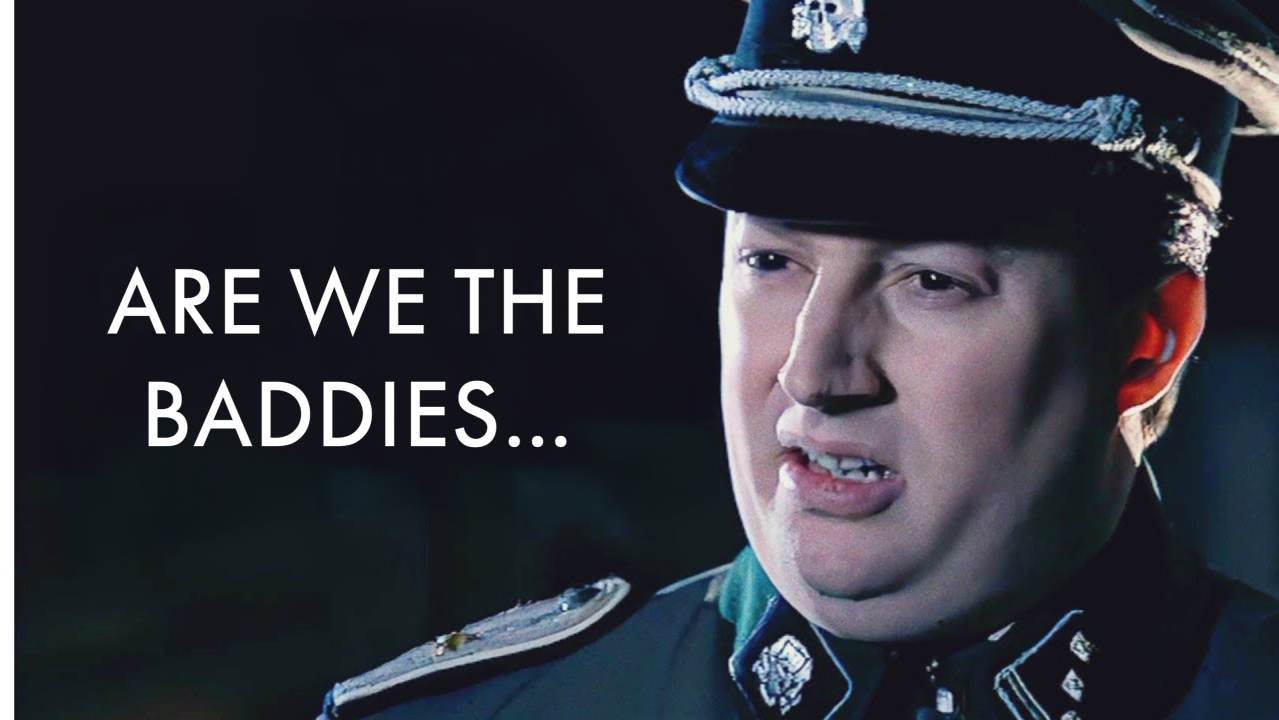
The British comedians Mitchell and Webb illustrated this idea perfectly in a sketch where they were both dressed up in Nazi uniforms. David Mitchell’s character, having looked at the skull insignia on his cap, quietly asks: “Are we the baddies?”
He was highlighting the fact that leaders, who are doing bad things, often believe they are doing the right thing.
They justify their unethical behaviour by rationalising their activity and claiming what they are doing is for the greater good when most of the time their actions are largely self-serving.
Similarly, many organisations, when defining their company values, claim to want to “do the right thing”. Or they declare that what matters to them is to “treat others as you want to be treated”.
But few organisations have had a moral debate with their employees on what’s the ‘right thing’ is and how they define this.
Even fewer leaders have studied morality or read the research on ethics. Hardly surprising then that more CEOs were removed from office for ethical misconduct in 2018 than for financial under performance, for the first time ever.
WHAT IS RIGHT AND WRONG
Is it possible to define what is ‘right’ or ‘wrong’?
Most people’s definition would be rooted in the laws of their land.
But if you’ve spent anytime interacting with the legal system, in any country, you quickly realise that the definition of what is ‘right’ isn’t that simple.
What is considered ‘right’ in most countries is more of a shifting cultural norm than a locked in legal standard.
So, again, how can we tell that leaders are doing the right thing?
Fortunately, Lawrence Kohlberg’s work on moral development provides a brilliant start point for our understanding. Kohlberg masterfully didn’t get stuck on an absolutist definition of whether WHAT someone does is immoral.
Instead he evaluated ‘moral reasoning’ or WHY people did what they did.
He demonstrated that morality doesn’t simply increase with age, education, or status. It develops in stages. Kohlberg defined six distinct levels of moral sophistication. Each level delivers an increase in the sophisticated of moral reasoning compared to the previous level.
But the world has become much more complicated since Kohlberg defined his six levels, more than fifty years ago.
We believe there are now 14 distinct levels of moral sophistication (which we measure).
And here’s the uncomfortable truth.
Many leaders are yet to make it beyond level 4 morality. This means many are incapable of recognising that they may be behaving in a way that most would consider unethical.
As a result it may not even occur to them that they may be doing something ‘wrong’, particularly if they are loyal, lawful, and successful.
From their level of moral sophistication, they believe they are good people doing the ‘right’ thing.
Their unethical behaviour isn’t a character flaw it’s just developmental immaturity.
BASIC MORALITY (LEVELS 1-5)
Let’s unpack the first five levels of morality from which most people operate.
As children our first understanding of what’s right and wrong is driven by the need to comply or be obedient. We are taught to “follow the rules”. These rules are handed to us by someone in authority, usually our parents. Later in life authority may be transferred to our boss, the government, our church
Level 1 morality is therefore driven by the need to avoid the punishment we might incur for breaking the rules.
The next four levels of morality are all largely driven by self-interest.
Level 2 operates independent of consequence. We are either blind or don’t care about the impact our behaviour may have on others. We saw this during the global financial crisis when some financiers on Wall Street were quite happy to manipulate the market for their own personal gain with zero regard to the economic consequences their actions had on others.
Level 3 morality recognises their may be negative consequences for others, but if actions can be justified, then the behaviour is claimed to be ethical. This level is typified by the “Might is Right” stance taken by some of our current political leaders. Righteous anger is another example of this level. But righteousness is a dangerous in whatever form it takes.
Level 4 morality is still largely self-serving. But this level at least aims to cause zero harm to others. My action may still be in my own self-interest, but if it doesn’t hurt anyone else then it is counted as ethical. People who advocate that we can or should keep burning fossil fuel for some years so long as we have a plan to achieve “Net Zero” carbon emissions at some point in the future is an example of this level of moral reasoning. The Hippocratic oath is another example of this level of reasoning.
Level 5 morality takes a more sophisticated view, albeit still self-interested. At level 5 it is not enough to do no harm, putting ourselves first is considered OK if our actions have a positive benefit for others.
So, an oil executive can continue to advocate for the consumption of fossil fuels so long as such activity is offset by carbon capture and storage plans; reforestation initiatives; investment funds directed at clean energy development in emerging nations; all in the service of becoming ‘Net Positive’. In this case their actions can be seen as ethical.
At these first five levels:
- Loyalty is seen as a virtue
- Morality if driven by authority
- Following rules is the definition of goodness
- Winning legitimises behaviour
In practice, this means:
- If I am loyal to my group, my nation, my party = I am good.
- If I follow the law (or only bend it enough to avoid being in court) = I am good.
- If I succeed = I am good.
As a result, the question “Are we the baddies?” never arises in these first five levels.
At levels 1-5 the “baddies” are, by definition, the other people.
This inability to check our own moral compass starts to explain how deeply unethical behaviour can coexist with a personal sense of ‘moral certainty’.
What makes this especially dangerous is that these basic levels of morality often look virtuous from the outside, especially to others operating at the same levels.
Leaders at these levels speak passionately about their values. They defend tradition and cultural identity. They invoke duty, heritage, and identity. They are utterly convinced of their own righteousness.
And yet, history shows us repeatedly that atrocities or a whole range of bad behaviours are rarely committed by people who believe they are evil or immoral.
They are committed by people who believe they are right.
HOW DO WE DEVELOP MORE ETHICAL LEADERS?
Moral development requires leaders to step outside their own worldview and question the very standards by which they judge yourself. It requires the ability to say:
“The fact that this feels right to me may be the problem.”
This ability doesn’t emerge automatically and power doesn’t create it. You don’t need to develop your moral maturity to be successful, and modern leadership systems rarely reward higher levels of it. In fact, they often punish it.
Leaders need to understand that there are many more levels of moral development than those first described by Kohlberg. Until they understand how they define what is ‘right’ and what is ‘wrong’ they will continue to make decisions that are internally justified and potentially externally devastating.
They may well sleep well at night, untroubled by the question “Are we the baddies?”
But such a question is one of the most developmentally advanced questions a leader can ask.
Not because it produces instant answers but because asking it destabilises the ego just enough to allow growth.
The real leadership challenge of our time is NOT to develop stronger convictions, or greater levels of certainty or righteousness but to develop the courage, and the developmental maturity, to pause, look at the symbols we’re wearing, the systems we’re defending, the outcomes we’re creating…
…and ask the question most leaders never will never ask:
ARE WE THE BADDIES?