

Yesterday, a retail CEO client said something quietly revealing.
“I’m starting to feel frustrated,” he told me. “I’m developing faster than my team. The gap is widening.”
He wasn’t being arrogant and there was no judgement in his voice. He was just making a simple observation. He said that six months ago tasks that took him two hours now take 20 minutes. Some of his increased speed came from better use of AI and technology. But much of it had come from his own development. He now thinks, integrates, prioritises and decides quicker than he did at with higher quality.
He has grown.
As a result, his relationship with his leadership team members was beginning to feel strained.
The conversation with the retail CEO reminded me of another conversation I had with a tech CEO a few years ago. The tech CEO ran one of the largest online dating platforms in Europe. He had built a suite of psychological assessments designed to predict whether two people’s first date would be a success. He was trying to ensure his clients’ first dates translated into longer-term relationships. Commercially this was his most important ROI, because if relationships sustained, he could use this to drive an increase in customer numbers joining his App.
Dating, he said, is a fascinating experiment. Two strangers meet. The outcome is almost binary. It works, or it doesn’t.
His technical team spent years mining their data to find predictors of success. They analysed personality traits, preferences, backgrounds, values, behaviours. And in the end, they found something both simple and challenging.
There was only one factor that predicted long-term relationship success.
Alignment on critical variables.
Not having the same interests; not similar levels of attractiveness.
Alignment.
This is why most dating apps struggle. People can spend months swiping on Tinder, Hinge, Bumble, Grindr or Raya, endlessly searching for the ‘right’ person, but rarely finding someone who they can relate to in a sustainable way. The failure rate has even spawned high-end intervention services — companies that focus less on matching others and more on developing you.
What struck me, listening to him, was how directly his single predictor mirrored what we’ve been teaching leadership teams for years.
Successful relationships, in teams, in organisations, and even in life, are driven by the ability to create shared understanding. Not agreement. Not compliance. Shared understanding.
Most people enter relationships operating from one of two perspectives.
They take a 1st person perspective, characterised by the “me, my, I” stance.
This view of the world is subjective, belief-driven and experiential. Leaders operating from the 1st person perspective say things like, “In my experience…” or “I strongly believe the right answer is…”. In such a stance there’s energy and conviction, sometimes vulnerability too.
The alternative stance people take in relationships is the 3rd person perspective. This is cooler, more detached, observational. It operates in the realm of data, evidence and analysis. Leaders here say, “The numbers tell a different story,” or “If we look at the evidence…”. This viewpoint is the preferred mode for most scientists, journalists and analysts.
Both perspectives are useful.
But relationships are not built in either.
All relationships are built in the 2nd person perspective. This is the realm where we create shared understanding; we align on something; we establish some form of commonality.
The difficulty for many people is that accessing 2nd person perspective is not easy. To get there we must temporarily set aside our certainty and our beliefs if we operate from 1st person perspective; or we must park our evidence if we operate from 3rd person perspective. We must do this long enough to co-create a shared view.
For many leaders, this feels like giving something up. “If I let go of my beliefs, who am I?” “If I ignore the facts, what am I standing on?”
So instead of aligning, we broadcast.
We assert.
We explain.
We try to “win” the debate, we get into negotiation mode. We seek capitulation to our point of view. We try to persuade, argue our corner, to get our way.
And no common ground is established. Just a load of opinions and information. No agreements.
This is not how we build sustainable relationships.
But if leaders develop, particularly in their ability to access 2nd person perspective they can move faster, take more people with them, create greater levels of integration deliver more sophisticated answers. Their capacity expands. They can hold more complexity, see patterns sooner, and act with greater coherence.
But if the people around them aren’t developing at a similar pace, the relationship gap grows even with goodwill on both sides.
This is where we teach the ability to ‘ZIP’ their relationships or their discussions.
The ‘ZIP skill’ is a developmental capability. It is a ladder of increasing sophistication. A way of building alignment and identifying where in the Zip the relationship may have become stuck. We’ve identified 12 levels that when completely zipped can predict relationship success and longevity with powerful accuracy, whether in a leadership team or in life. The 12 levels of alignment are from the bottom up:
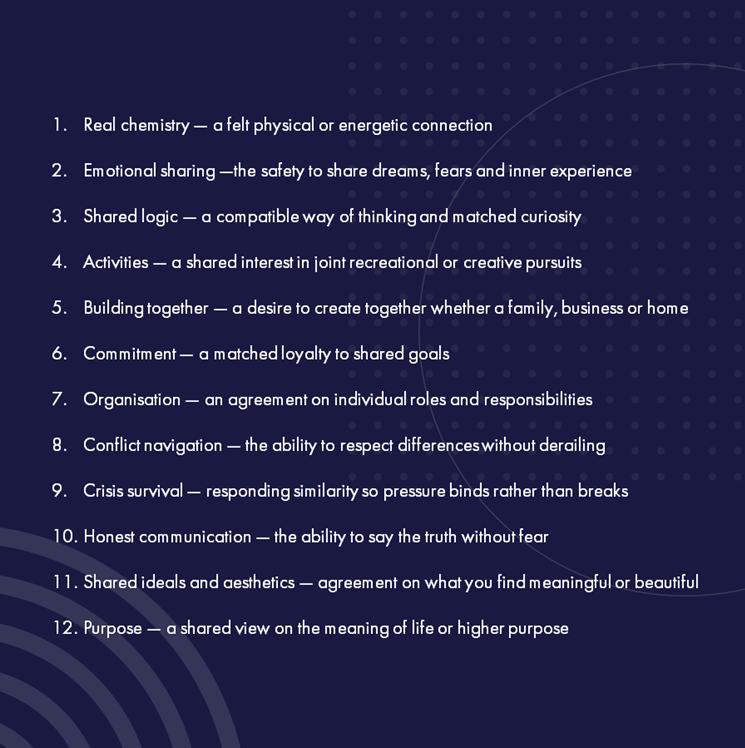
The more levels you can zip up with someone, the more sustainable the relationship becomes.
But here’s the key insight - as we live our lives we develop at different rates.
A leader may mature through experience or coaching. Our partner may grow up and see life differently. Our view of these 12 levels and their importance changes. The sophistication with which we approach every level changes.
If we don’t mind the gap between our level of sophistication and the people we relate to, then it’s inevitable that frustration brews, disengagement starts and a quiet withdrawal follows.
What we must do is notice the gap, name it without blame, and work together to build our shared understanding on all 12 levels.
Vertical development gives leaders speed, clarity and capacity. But relationship longevity depends on something subtler: the willingness to develop our 2nd person perspective taking and meet others in the space between us, level by level.
So, the question isn’t, “Why can’t they keep up?”
But rather, “Where are we no longer zipped?” and “how do we mind the gap and realign?”
So, try that.
Notice the alignment gaps in your relationships and work to close them – zip up!
If you do you should start to enjoy much stronger, healthier, enduring relationships with the important people around you.