
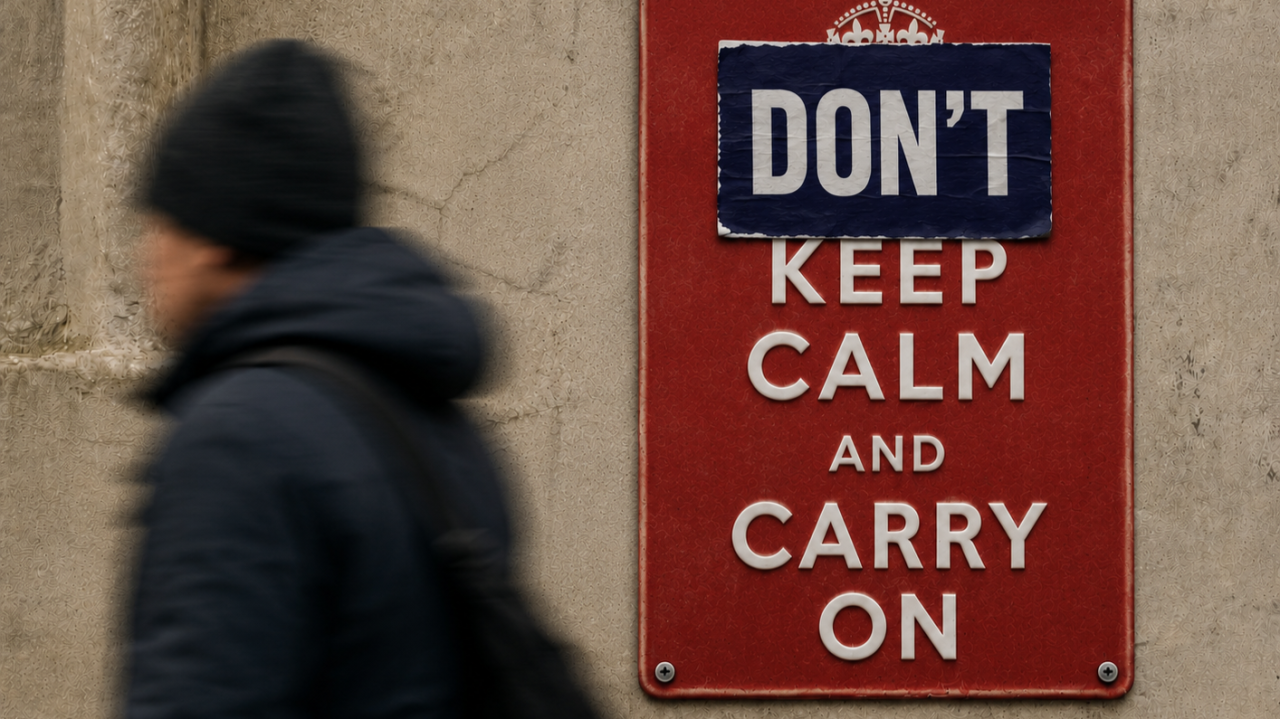
There's a leadership quality that has been extolled for decades, particularly in the UK, namely that it’s important for leaders to “Keep Calm and Carry On”.
This message of sober restraint was invented by Britain’s Ministry of Information in June 1939, nearly 90 years ago. Nearly 2.5 million posters were printed to disseminate the message, only to be pulped and recycled a year later to help the British wartime government deal with a serious paper shortage!
Sixty years later, in 2000, a copy of the original poster was discovered in a bookshop in Northumberland, and the idea saw a massive resurgence, possibly because the Brits are the “Stiff Upper Lip” world champions. Here in Blighty we like to mask our fear of being embarrassed or looking stupid.
This quintessentially British idea, of showing no emotion, seems to have been embraced by virtually every corporate leadership framework which now suggests that emotional stability is a virtue. Boards prize it. Succession planners look for it. Executive coaches try to build it.
But during my deep research while I've been building a rigorous framework for measuring emotional and social intelligence, it became clear that the vast majority of "emotionally stable" leaders may be “stable” in ways that are quietly damaging to their organisations, their teams, and ultimately themselves.
The problem is not the destination, i.e., emotional stability, it’s how leaders get there.
The Three Wrong Roads to Emotional Stability
1. The first road is ignorance
Some leaders are emotional quite stable simply because they don’t register what’s happening around them, emotionally. They’re not suppressing anything and they’re not managing anything. They are just even aware of their own or other peoples’ emotional state. Their inner life is relatively quiet because their emotional radar is switched off. A sort of corporate alexithymia.
This is not strength. It’s a form of sensory poverty. The organisation around them is humming with signals such as fear in the team, resentment between functions, grief after a restructure, collective anxiety about the future and many more. The leader notices virtually none of it. They appear composed because they are, in the most literal sense, emotionally blind.
We sometimes admire these leaders. We describe them as "unflappable." What we’re actually describing is a lack of awareness dressed up as stability.
2. The second road is insensitivity
A subtler and more common path is insensitivity. On this path leaders know emotions exist. They aren’t oblivious. But somewhere on their development journey, or as a result of the corporate cultures they’ve lived in, or because they’ve been worn down by the accumulated pressure and cynicism of commercial demands over many years, they’ve habituated to the sharpness of emotions. To survive, they’ve disconnected from what they feel. The emotional signals arrive but they are not processed. The emotion is present but never inhabited. Such insensitivity is sold as a virtue by inurement narratives that are common in macho male circles.
Insensitive leaders are often high performers. They are decisive, efficient, and apparently untroubled by the emotional weight of difficult decisions. What they don't realise is that the emotion in themselves and others have not disappeared. They have gone underground. Suppressed emotions may emerge later as shortened temper at unexpected moments; as a strange flatness in their relationships; as decisions that are technically rational but emotionally tone-deaf in their delivery; or an inability to read the room, when they may have lost the team.
Such leaders are not calm. They are numbed.
3. The third road is stoicism of the wrong kind.
This is perhaps the most celebrated, and the most dangerous. The leader who "sucks it up." Who carries it. Who models toughness by refusing to let anything show, and who, often unconsciously, communicates to everyone around them that emotion is weakness and vulnerability is something to be managed out of the system.
This is not stoicism in the philosophical tradition. Marcus Aurelius and the Stoics, who are not some ancient Roman ever boy band, did not advocate the suppression of feeling. They suggested it was important to distinguish what's within your control from what's not. This is differentiation not a stiff upper lip. What passes for stoicism, in most corporate cultures, is closer to emotional suppression, with a fake macho manosphere mythology attached to it. Suppression is immature, it's costly, and it creates a repressed organisation in its own image.
What advanced levels of emotional and social intelligence reveal is that there is a much wiser, more nuanced and more sophisticated road to emotional stability, and that is: Non-Attachment
This Buddhist idea or 'non-attachment' is more sophisticated than anything in the Western leadership canon on the subject of emotional stability, and it is time corporate leaders took it seriously.
Non-attachment or ‘upekkha’ in the Pali tradition, or ‘vairāgya’ in Sanskrit, is not the absence of feeling. It is the capacity to feel fully without being owned by what you feel. The emotion moves through you. You are not the emotion. You witness it. You can act from it wisely rather than react from it blindly.
This is a radical distinction and a sign of advanced emotional intelligence and stability.
An ignorant leader does not feel. An insensitive leader feels but has disconnected. The macho-stoic leader feels, suppresses, and pays the price in private. A non-attached leader feels, sometimes intensely, and remains free. They are moved, without being swept away. They are present to the full emotional reality of a situation without being captured by it.
The practical implications for leadership are significant.
A leader practising non-attachment can receive genuinely bad news without shooting the messenger, because they are not using suppression to manage their response. They can sit with uncertainty without forcing a premature decision, because the discomfort of not-knowing is not threatening their sense of self. They can witness the suffering of a team member without either collapsing into it or dismissing it, because they have a stable relationship with their own emotional life.
They can also, critically, let go. Of positions. Of egos. Of strategies that have stopped working. Of identities that their role has outgrown. The non-attached leader doesn’t hold on with a vice-like grip. Non-attachment delivers true strategic agility, not frameworks or methodologies, but the inner freedom to release what no longer serves.
Such Emotional Stability is Measurable
One of the central challenges in assessing emotional intelligence is that the three dysfunctional forms of emotional stability, i.e., ignorance, insensitivity, and suppression can look identical from the outside. All three produce a leader who appears calm under pressure. All three score well on superficial assessments of "composure." All three leaders will tell you, and believe, that they handle stress well.
Distinguishing them requires assessment tools sophisticated enough to probe not just behaviour but its underlying mechanism. Not just ‘what’ a leader does under pressure, but ‘how’ they’re able to do it. What is the source of their calmness? What would happen if the pressure doubled? What does the leader actually feel, and what is their relationship to that feeling?
This is the level of resolution that emotional intelligence assessments need to reach if there are to be genuinely useful at the top of organisations, where the stakes of getting it wrong are highest.
The Big Question
As the world becomes more brittle, anxious, nonlinear and incomprehensible (BANI, is the new VUCA) leaders need to be more emotionally stable.
The big question is how you achieve emotional stability. Which road did you take to get there.
Because leadership is a human act.
And the quality of that act depends entirely on the maturity of the human performing it.
ent approaches.